

Now is Not the Time to Panic for Canada, That Comes Later: Part One
Better to lose now than lose in February, but Canada needs to take the lessons given to them in the Rivalry Series to heart.
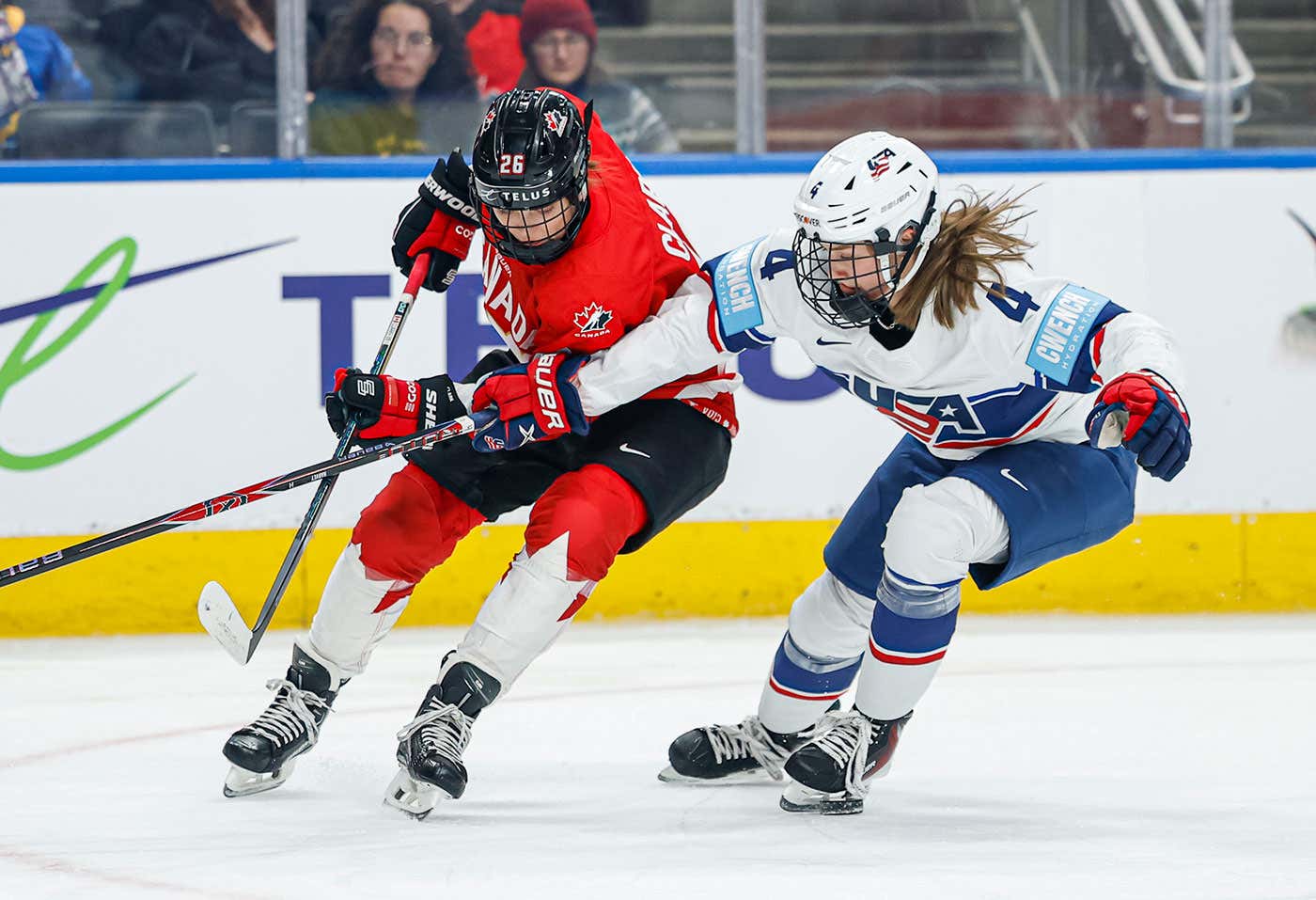
Canada hasn’t won a game against the United States since February 8, 2025, in Summerside, PEI, as part of the 2024-25 Rivalry Series. Since then, Canada went on to lose both games against the United States at the 2025 Women’s Worlds in Czechia and all four games of the most recent Rivalry Series, which wrapped up this past Saturday in Edmonton. From where Canadian fans are sitting, it looks like it's time to break glass and hit the big red button labelled “PANIC!”
I can hardly blame them, as they’ve watched Canada lose six games in a row to the U.S., and two of the most recent four games were definitive blowouts. The other two games weren’t much better, with 4-1 losses. With all that in mind, why am I telling Canadians not to panic? The evidence up to this point suggests that all that should be happening is panic.
I know that the feeling right now is that Canada looks overwhelmed in nearly every facet, and once again, it's hard to blame anyone who has those feelings. However, it’s important to remember that Canada boasts a high share of the best talent in the world. The only two PWHL MVPs were Canadian, both PWHL Defender of the Year winners were Canadian, both PWHL Goalie of the Year winners were Canadian, and both PWHL Forward of the Year winners were Canadian. Let’s keep going: seven of the top 10 point-getters in the PWHL were Canadian and half of the top 10 in PWHL goals were Canadian. The best league in women’s hockey is filled with elite Canadian talent.
Did that talent show up against the U.S. in the Rivalry Series? In spurts, yes, but otherwise, no. However, I don’t believe this type of talent just ceases to exist. Let’s not forget that Canada has won the 2022-23, 2023-24, and 2024-25 Rivalry Series’. The first two in that list were reverse sweeps, where it was Canada’s pro talent versus the U.S.’s pro talent in the last three or four games, depending on the series schedule. The 2024-25 Rivalry Series was a 3-2 series win for Canada, with Canada thoroughly outplaying the U.S. in the last three games and losing only one of those games in a shootout.
From all the historical data we have, these teams have always been close, and there’s no reason to think the U.S. has randomly become a significantly better team talent-wise. Let’s not get confused here—I’m not calling the U.S. untalented. They also have a plethora of elite talent that has clearly matched up well with Canada over the years. These teams essentially play 0.500 hockey against each other and hope that they’re due a win in the gold medal game of whatever tournament they’re playing in. It’s impossible for these teams to not have close games. Just look at the 2022 Olympics, where Canada had a +47 goal differential and still only won 3-2 in the gold medal game to the U.S. while nearly blowing a 3-0 lead in the process.
There’s definitely plenty to criticize the Canadian players on coming out of the 2025-26 Rivalry Series. While I don’t think they were taking games off, I think it was clear the U.S. wanted to win more than Canada did. Nearly every Canadian player underperformed and looked nowhere near what they should look like. While the immediate reaction is to panic—and panic a lot—I think such poor play from these players still provides positives.
“A good core memory of mine” 😂💃@natspooner5 and @wick_22 did a flash mob with the 2012 worlds team, and Canada would end up winning gold 5-4 in OT against the U.S. 🇨🇦🏒@HockeyCanada
— CBC Sports (@cbcsports) April 8, 2025
Women's hockey worlds preview here: https://t.co/dcSgI7fIol pic.twitter.com/9KDG0UVYHt
I know it sounds like delusion mixed with optimism, and maybe it is. Maybe it’s a symptom of watching hockey for more decades than I care to admit. When players this great perform this poorly, you can usually be guaranteed that they’ll bounce back. Canada has a veteran roster, which comes with its upsides and downsides. The upside is these veterans have been here and done that. When they need to flip the switch and play their absolute best in a short tournament, they know how to do it. They know how to come back after a bad loss. They know how to come back in games.
The other upside with these games being so disastrous for the players is having the experience to overcome adversity. It’s definitely possible a team is able to just run over everyone, never lose a game, and win a Gold Medal. When Canada and the U.S. exist, plus the recent rise of Sweden and Czechia, I believe the days of getting through a tournament without dealing with hardship are over. You’re going to end up in high pressure situations where it feels like the game is collapsing around you and you have to push through. Sometimes you need to experience the worst possible outcome to realize the world hasn’t ended and life moves on.
What does it take to #feedthedream?
— Hockey Canada (@HockeyCanada) January 13, 2022
A gruelling centralization season began last September for 🇨🇦’s National Women’s Team. Learn how 29 players kept their bodies and minds healthy as they chased their Olympic dreams.
@sobeys pic.twitter.com/34QYm43qBo
Usually, Team Canada management and the coaching staff achieved this through the Centralization process. For those that don’t know what Centralization is, it’s the process the Canadian and U.S. national teams typically go through leading up to the Olympics. All the players vying for spots are led through a very long training camp, with some parts akin to boot camp. For Canada specifically, the goal was making Centralization the toughest experience possible so that when it came to the Olympics, the Olympics would feel easier in comparison. Or in other words, the idea was to make them climb mountains so the Olympics felt like a hill.
That idea clearly worked for Canada, as they possess five gold medals compared to the U.S.’s two gold medals in the Olympics. Now with the PWHL, Centralization has been discontinued and Canada and USA have needed to adapt. One can assume that currently Canada is adapting poorly and the USA have adapted very well. I have no evidence to contradict that. What this led to might be what Canada needed, and it was a harsh slap to the face, the kind of open-handed slap that hurts more on the inside than the outside.
The Rivalry Series was an embarrassment for nearly everyone Canadian. The amount of positive performances over the four Rivalry Series games can probably be counted on one hand. Kristen O’Neill played her role exactly how she should have. Sophie Jaques has looked like one of the few offensive sparks on the backend. Sarah Fillier has been all over the ice doing her thing. Chloe Primerano is clearly the most talented blueliner on the backend. Caitlin Kreamer should have solidified her spot with Game Four of the Rivalry Series, showing she has the skill of everyone she’s fighting for a spot against, with the ability to make an impact in a limited bottom six role. It's nearly impossible to evaluate the goaltending, considering how the U18 national team has been seen playing better defence than the senior team thus far.
The whole team should be feeling terrible for a night, and I think they will. These are proud players who don’t get this far in hockey and accomplish all they have because they’re ok with losing. They come off as very nice people off the ice and on social media. I’d hate to face any of them playing angry on the ice, though. They’ve now been given all the motivation they could possibly ask for heading into the Olympics. They were outscored 14-5 on home ice in Edmonton. You carry that with you, and being veterans, they’ve carried hard loses. They know how to handle them, and I believe that they’re too talented and too motivated to be this much of an uncompetitive team in the Olympics.
Unless you live under a rock, the U.S. running with Laila Edwards, Abbey Murphy, Caroline Harvey, Lacey Eden, Tessa Janecke, Joy Dunne, and Kirsten Simms on their roster has brought up the question of whether Canada should be doing a youth movement or if it's even too late to do a youth movement? Those are all very talented players, but as I just showed above, Canada isn’t lacking in elite talent. Canada’s roster has proven itself to be filled with the best players from the best league.
It’s not like the Canadian roster has been lacking youth, either. Danielle Serdachny and Julia Gosling are only two years out of college. Chloe Primerano made the last Worlds roster as the youngest player since Marie-Philip Poulin. They’ve invited Caitlin Kraemer to fight for a roster spot, and she looks like she could make it. There’s a fair amount of players who are only three years out of college on the Canadian roster—it’s not old and slow. The other part of this is: who would you even add? The only name that really comes to mind as someone who should have been fighting for a spot with everyone is Jocelyn Amos. Canada has a great wave of players coming from the 2023 and 2024 U18 teams, but they aren’t quite ready to start knocking off PWHL pros. The answer is mostly already on the roster, unless we see a Canadian in the PWHL go off and make it clear they need to go to Milan.
Comments ()