

Elaine Chuli Reflects on Nine Seasons of Pro Women's Hockey
Across three different leagues and one barnstorming tour, six teams, three cities and two continents, Elaine Chuli has seen firsthand the development of professional women's hockey.
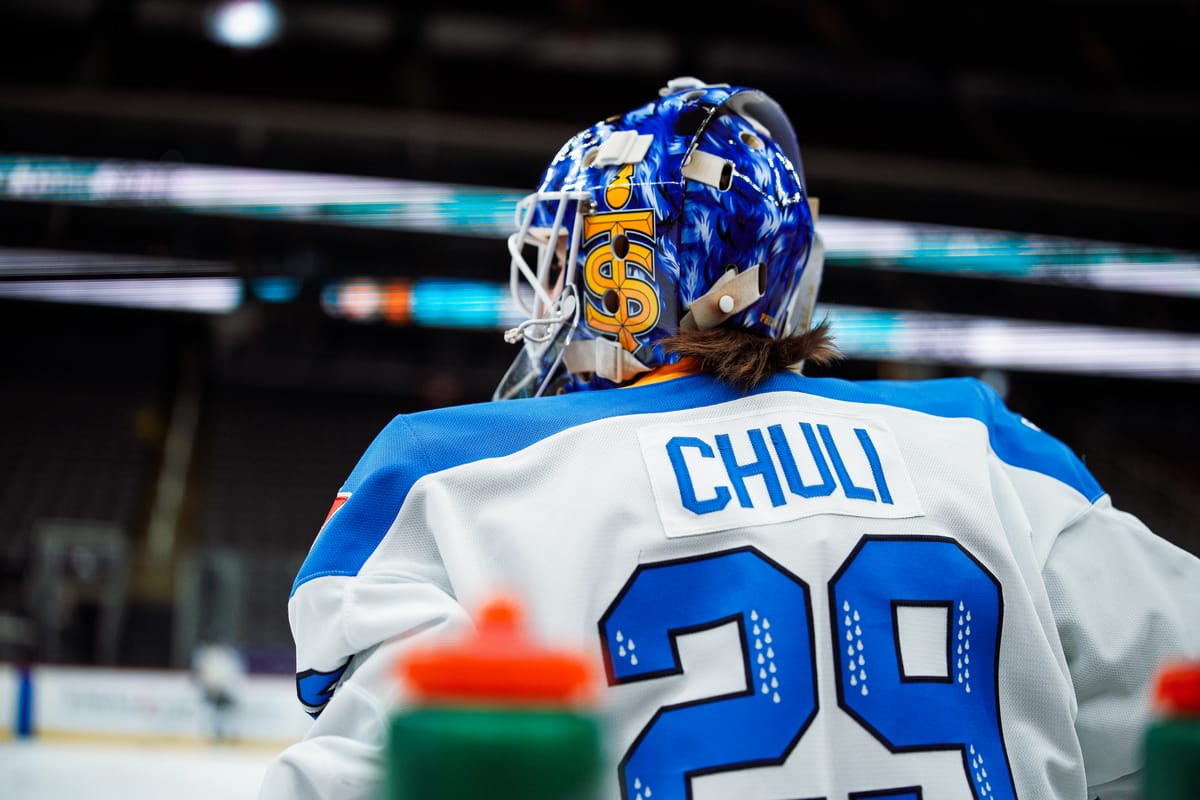
In the nearly ten years since she graduated from the University of Connecticut, Elaine Chuli has lived many hockey lives. Across three different leagues and one barnstorming tour, six teams, three cities and two continents, the 31-year-old has seen firsthand the development of professional women's hockey, through the highs and the lows.
"It's grown tremendously," Chuli told The Ice Garden. "To see where we're come from, with the Canadian Women's Hockey League (CWHL) and then the NWHL, the PHF and now the PWHL... every year, it seems to get better. More resources, better facilities - literally everything. More staff, more time."
Chuli graduated from UConn in 2016 and joined the CWHL's Vanke Rays in 2017, the team's lone season in the league as part of a development to grow interest in ice hockey in China. She played the lion's share that season, sporting a 2.94 GAA and .913 save percentage and going 14-11-1.
Then, not for the last time in her career, the team she'd been playing for was folded, as the Rays were merged with the Kunlun Red Star to become the Shenzhen KRS Vanke Rays. Chuli returned home to North America, signing with the Toronto Furies for the 2018-19 season. There, her workload was halved, as she shared the net with Shea Tiley and finished the season with a 7-7-0 record.
The #CWHL saw two debuts last night, Elaine Chuli of the Vanke Rays who posted a 23-save shutout vs the Furies & Lindsey Post
— Giants in the Crease (@CreaseGiants) October 29, 2017
The CWHL wasn't perfect - for instance, the league didn't start paying its players until Chuli's second season - but the pro league was on point for what women's hockey had to offer at the time.
"That's what we had at that time, and we're grateful for that," Chuli said. "We made the most of what we had. We didn't have the funding and the resources that we have now, but we made the most of it. Without those leagues, a lot of us wouldn't be here today still playing."
"We just showed up every day and worked hard," she added. "We're doing the same things now, it's just now, maybe you're getting paid more for it."
Following her second season in the CWHL, the women's hockey landscape in North America saw landslide developments. First, the CWHL folded. Then, the PWHPA emerged from the ashes, as players including Chuli began to form a group determined to create a sustainable pro league.
Chuli spent the next year with the PWHPA's GTA West squad and participating in the Dream Gap Tour. The season was cut short due to the COVID-19 pandemic.
She'd go on to play the next three seasons in the NWHL/PHF with the Toronto Six, where she became one of the top netminders in the league on the emerging team. In her second season in the league, Chuli had an astounding 16-1-0 record with a 1.82 GAA and was named the league's goaltender of the year. The following year, she became an Isobel Cup champion.
Elaine Chuli is your 2022 PHF Goaltender of the Year 🏆🙌 pic.twitter.com/HXAemfbBAQ
— PHF (@PHF) May 19, 2022
Then, once again, the league Chuli was playing in folded overnight. This time, from the ashes came the PWHL.
Chuli was drafted in the 13th round, 78th overall, by Montréal. She was the last of eight goalies to be selected, and it meant one thing: she'd get to keep playing pro hockey for at least another year or two. She'd play the next two seasons alongside Ann-Renée Desbiens in Montréal and put up respectable numbers, including a 1.61 GAA and .949 save percentage in the first season and a 2.42 GAA in the second.
After two years in Montréal, Chuli found herself with the opportunity to return to Toronto. She signed a one-year deal with the Sceptres in mid-June, just days before the team traded starting goaltender Kristen Campbell in a blockbuster draft day deal.
She's now played on every iteration of pro women's hockey in the city: the Furies, the Six, and the Sceptres, and marvels at the growth over the years.
Elaine Chuli officially becomes the first goaltender to start (and win) a game for all three of Toronto's professional women's hockey franchises: the Furies (CWHL), the Six (PHF) and the Sceptres (PWHL).#PWHL pic.twitter.com/r0inRQb0gL
— Melissa Burgess (@_MelissaBurgess) December 5, 2025
"The crowds and the turnout we get for our home games speaks for itself," she said. "It's pretty incredible to see, going from playing with the Furies and having a few hundred people there to now consistently pretty much selling out Coca-Cola Coliseum. Now, we have the resources to make this possible. It's cool to have such big support now."
Through our conversation, Chuli makes one thing clear: she absolutely loves playing hockey. It's part of why she's continued to do it all these years, across multiple continents and various leagues. But it's not her only passion in life; in addition to playing professional hockey full time, she is also a full-time accountant, running her own firm with a colleague when she has free time.
Elaine Chuli used to be co-workers with Raygan Kirk’s mom when she was an accountant.
— Kyle Cushman (@Kyle_Cush) November 13, 2025
Now, Chuli and Kirk comprise the Toronto Sceptres’ goaltending tandem this season.
“Small world,” Kirk said. “I heard a lot about her when she was playing with the Six and I was in college.”
"It comes down to finances, really. It's good to supplement my income," she said. "I like to have a couple different income streams. I've always had it like that, it keeps my mind fresh. It's something totally away from the rink that I can do in my spare time and keep my mind sharp. It's just honestly kind of necessary to make all this possible still."
"It's something I can grow with as I have time and as things change in the future," she added. "It's something I can put some time into now and then also enjoy once I'm done [playing hockey.]"
Through all of it, and despite all the tumult she's dealt with amid teams and leagues folding, Chuli has a lot of positive memories of her time playing hockey.
A few of her favorite moments?
"Starting the Toronto Six organization from scratch, building that into what we had and then, a couple years later, winning the Isobel Cup. Then, once again, starting a new team again in Montréal (in the PWHL), re-growing and then re-seeing what the new league was going to look like," she said.
Rally towels: activated 😎 @PWHL_Toronto pic.twitter.com/0qf5ZIPxSq
— Scotiabank Arena (@ScotiabankArena) January 17, 2026
Fast forward a few years, and now, Chuli and the Sceptres aren't just selling out Coca-Cola Coliseum. The team nearly sold out Scotiabank Arena with a crowd of 17,856 at the Battle on Bay Street - a crowd filled with folks in Sceptres gear, sporting jerseys with players names on the back, with signs of encouragement and energy throughout the bowl. It's a far cry from the days when maybe a hundred people - on a good day - would file into Mastercard Centre to watch the Furies play.
Women's hockey has come a long way in the last nine years, and few know it better than Chuli. As she appreciates the PWHL and the current environment she gets to play in, she also reflects back with fondness and respect for her prior pro experience.
"Like I said earlier, a lot of us wouldn't even be playing still if it weren't for these previous iterations of leagues," she said. "I really enjoyed my time on both the Furies and with the Toronto Six. We had a really great group, and it was pretty cool to start making a little bit more money to do what you love. We came to work every day because we loved hockey, and it's pretty cool to see where we've come since then."


Comments ()