

Designing PWHL “Reverse Retro” Jerseys, Part 2: The Americans
The PWHL’s American teams get their own local history-inspired jersey designs.

Welcome back to the PWHL reverse retro project! If you missed the first installment, I (LJ, host of The Ice Garden Podcast Network’s “Purple Posts” and hockey jersey design aficionado) drew up some third jersey concepts for all eight PWHL teams, inspired by each city’s local women’s hockey history. Last week, I tackled the Canadian teams, so you can find those here:
 LJ Bachenheimer
This week, it’s all about the Americans, with tributes to some beloved PHF jerseys and homages to some groundbreaking old-timey hockey teams.
Seattle Torrent
The Design
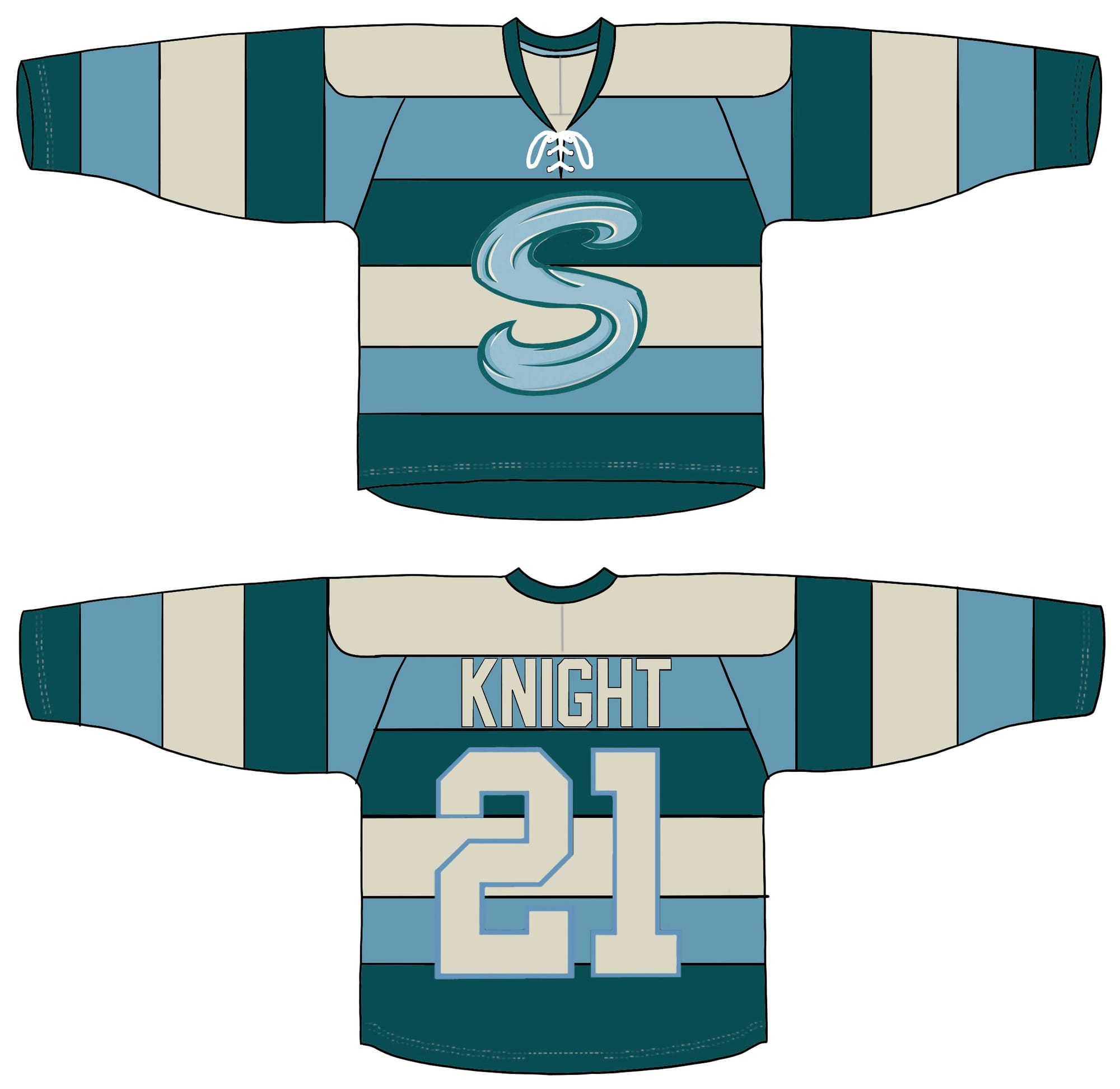
We’re kicking things off with a real throwback! This very stripe-y design pays homage to the Seattle Vamps, one of the Emerald City’s first women’s hockey teams. The retro feel of this jersey comes from six horizontal stripes in Torrent colors, with an emphasis on cream in the shoulder yoke, middle stripe, and name and numbers for the faux-back vibe.
If the Torrent logo seems a little off, that’s because I took out the text! I notably do not like the city or team name on logos, and I think this logo looks better without the team name plastered atop it. Plus, with just a curly S, this version bears more resemblance to the S in the wordmark the Vamps had on their sweaters.
The History
The Seattle Vamps were founded in 1921 to compete in an international women’s hockey tournament between the U.S. and Canada organized by the Pacific Coast Hockey Association men’s league. The tournament, which also featured the Vancouver Amazons and Victoria Kewpies, staged women’s games before and in the intermissions of men’s league matches. The Vamps were not the first women’s hockey team in Seattle—that honor goes to the “Hockeyettes,” an exhibition team founded in 1917 by the wives of the Stanley Cup-winning Seattle Metropolitans—but they were among the first to play competitively, and participated in what may have been the first international women’s hockey tournament with more than two teams. Unfortunately for the Vamps, that didn’t go so well, as they lost every game they played in the 1921 International Ladies Hockey League tournament to the Vancouver and Victoria teams, though they did win against a team from the University of British Columbia, including with a hat trick for captain Jerry Reed. The Seattle Vamps folded at the end of 1921, but garnered praise and news attention during their tenure, proving that Seattle's been a women’s hockey city for over one hundred years before the PWHL expanded to the Emerald City.
Minnesota Frost
The Design
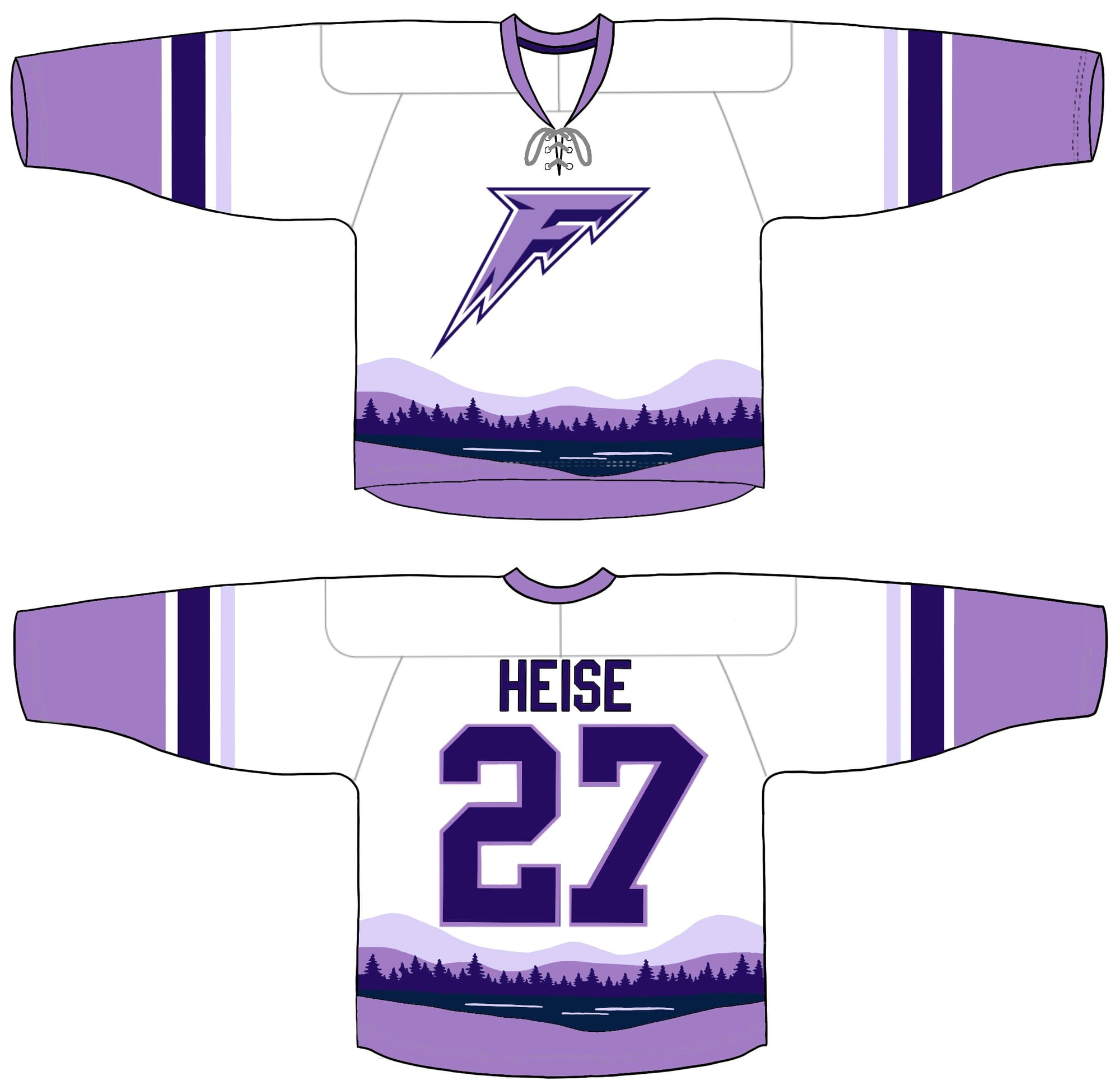
For the Frost, in perhaps my favorite design of the American set, I lovingly ripped off the Minnesota Whitecaps’ iconic “Land of 1,000 Lakes” jersey. I talked about how much I adore the original in my first jersey review for TIG, and even though the Whitecaps no longer exist, this design deserves to live on, and it totally works for the Frost.
The focal point of the jersey is the lake scene along the hem, with clouds and rolling hills silhouetting a rippling lake in the woods. It’s detailed enough to be striking, but simple enough to fit within the confines of a hockey jersey, even from a distance. I also think the lake scene looks particularly nice in the Frost’s purple color scheme, and the detail of the design at the waist helps balance out some of the open space on the torso left by the Frost’s asymmetric logo. The look is rounded out by simple striping and purple cuffs on the sleeves, plus bold names and numbers in dark purple on top of the white base.
The History
The Minnesota Whitecaps were women’s hockey in the 2000s. No one has a more extensive legacy than this team, which lasted through multiple leagues and all sorts of turmoil through dedication, community support, and love of the game.
The Whitecaps were founded in 2004 by two Twin Cities hockey dads who wanted their very successful daughters, Winny Brodt-Brown and Jenny Schmigdal-Potter, to have a place to play after college. They were a founding member of the Western Women’s Hockey League (WWHL) and the only American team, competing against clubs like the Calgary Oval X-Treme and Edmonton Chimos. The Whitecaps were WWHL regular season champions for the 2008–09, 2009–10 and 2010–11 seasons and competed against CWHL teams to win the Clarkson Cup. After losing to the Montréal Stars in the Clarkson Cup finals in 2009, the Whitecaps earned the trophy in 2010, becoming the first American team to win the Clarkson Cup, traditionally awarded to Canada’s women’s hockey champion.
In 2011, the WWHL merged with the CWHL and eliminated most of the WWHL teams, leaving the Minnesota Whitecaps without a home. Unwilling to not play, the Whitecaps forged ahead as an independent exhibition team, mostly playing NCAA women’s hockey teams and supporting themselves with donated ice time and clinic fundraisers with local youth teams. After a few years in the wild west, the Minnesota Whitecaps joined the NWHL as that league’s first expansion team in 2018, and they were instantly successful. They won the Isobel Cup in their inaugural season, becoming the first and only team so win both the Isobel and Clarkson Cups. With the exception of the 2021-22 season, the Whitecaps played in every Isobel Cup final during their five years in the NWHL/PHF.
Though the team ceased to exist when the PWHL ownership bought out the PHF, the Whitecaps left an indelible mark on the landscape of women’s hockey in Minnesota. Numerous notable players donned a Whitecaps jersey over the years, from legends of the game like Julie Chu, Natalie Darwitz, Manon Rheaume, and Angela Ruggiero to NWHL/PHF fan favorites like Allie Thunstrom, Jonna Albers, Audra Morrison, and Amanda Leveille (plus The Ice Garden family’s own Allie (Morse) Osen). Current PWHL players who were one-time Whitecaps include Kendall Coyne-Schofield, Lee Stecklein, Amanda Boulier, Natalie Snodgrass, Sidney Morin, Liz Schepers, and Denisa Křížová. The Whitecaps had so much history and did so much for women’s hockey in Minnesota that a PWHL tribute to them is rightfully deserved.
New York Sirens
The Design
New York was probably the hardest team to settle on a design for. There was the PHF’s Metropolitan Riveters, who wore many looks over their tenure, but PWHL New York played in Connecticut for its first year of existence, so that also includes the territory of the PHF’s Connecticut Whale. You could even make the argument (though it may be a stretch) that the Sirens could claim the legacy of New York State’s real PHF team, the Buffalo Beauts.
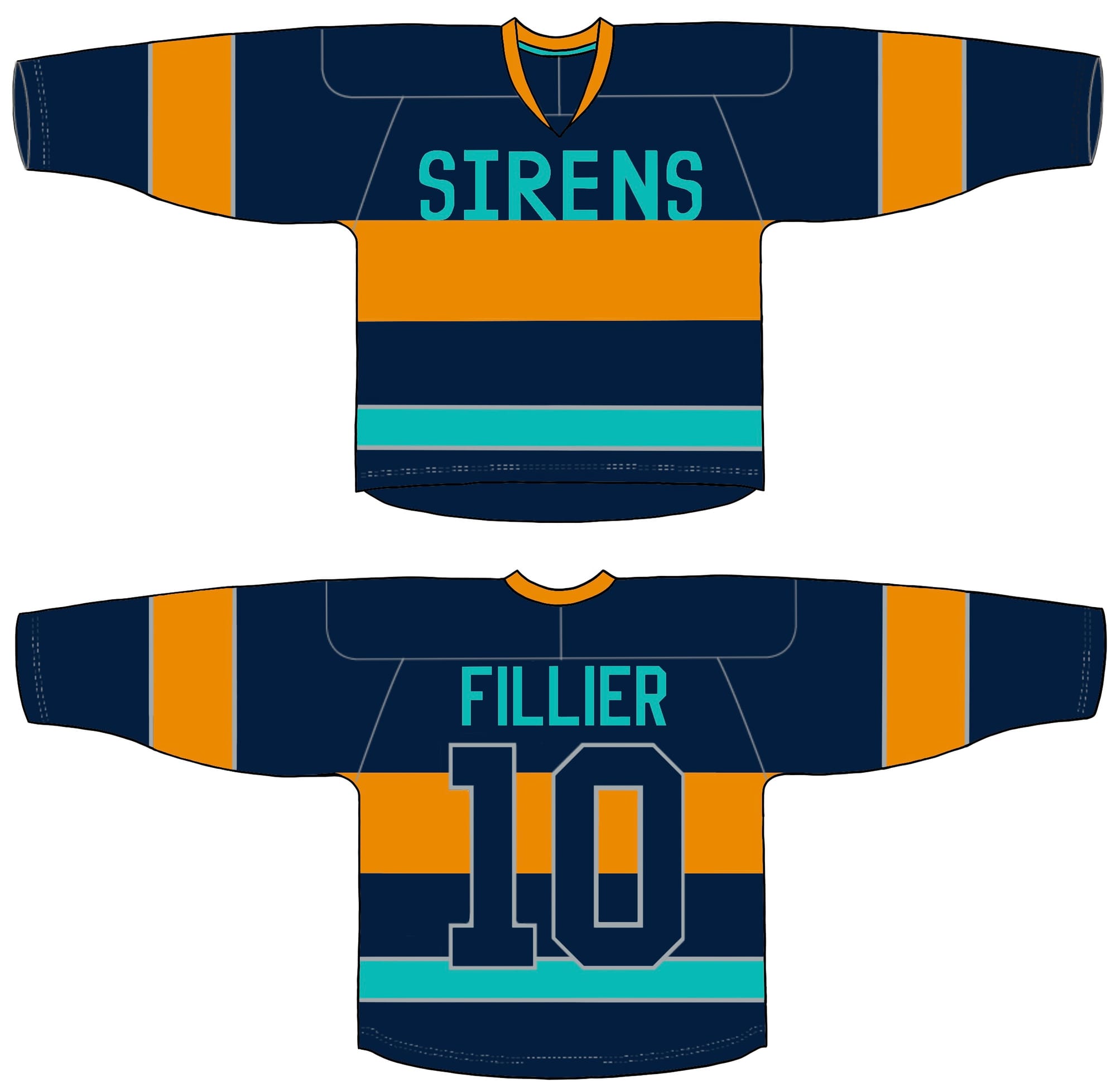
So in an effort to stay team-agnostic (and not overload this list with too many PHF homages), I chose to go in a more old-timey direction. This Sirens concept draws from the simple sweaters of the St. Nicholas Blues, a New York City women’s team from the early 20th century. In one of the few photos of the team I could find, they wore dark sweaters with “ST N.” and a single stripe across the chest.
I adapted this look for the Sirens, spelling out their team name high on the chest with a thick orange stripe underneath, all on top of a navy blue base. I carried the orange stripe onto the sleeves, and then to help break everything up and add some more color, put a teal stripe at the waist. My favorite part of this design might actually be the back of the jersey, where navy blue numbers with a gray outline interrupt the colored stripes, creating contrast. It’s a jersey that brings an old look into a new age by adding some modern style.
The History
The St. Nicholas Blues were the women’s hockey team that played out of New York City’s famed St. Nicholas Ice Arena, one of the earliest indoor rinks with mechanically frozen ice. Hobey Baker, the early American hockey star and namesake of the NCAA award, played for the St. Nicholas men’s team in 1914 and 1915. The Blues team was founded in 1916 by Kathleen Howard, a Canadian transplant who moved to New York with her hockey player husband and wanted a place to play herself. Howard was a leading advocate for women’s hockey in the early 20th century, telling local press that “there is no reason why a woman who can skate well should not develop into a hockey player,” and staging tournaments and exhibitions to grow the game on the East Coast.
On March 22, 1917, the first recorded women’s hockey game between American cities took place, featuring the St. Nicholas Blues against the Boston Girls Hockey Club at the then-new Boston Arena (aka the recently-closed Matthews Arena). It was the home team’s game and Boston won 3-2 over the Blues. However, the more-experienced Blues got their revenge when the series returned home to New York, though, with the St. Nicholas club defeating Boston Girls 1-0 and 3-2 on March 24 and 30. The Blues’ star player was captain and rover Elsie Miller, an all-around sportswoman who later represented the United States in speed skating at the 1932 Winter Olympics in Lake Placid, NY.
Boston Fleet

The Design
And last but not least, Boston. As much as I have to owe it to the CWHL’s Boston/Worcester Blades, there was only one real option for a team to reference with this design, and that’s the PHF’s Boston Pride. The Pride’s championship-winning black and yellow gradient sweaters were so iconic and so successful both on the ice and as a design that they made the perfect inspiration for these Fleet jerseys.
Instead of going dark to light, I flipped the gradient of the originals, with a white base drifting into dark Fleet green along the cuffs and jersey hem. The “BOSTON” wordmark is borrowed straight from the Pride (though I did adjust the positioning to eliminate some blank space), as are the contrasting stripes on the sleeves. And just to add another color that wasn’t white or dark green, the numbers are in the lighter mint green the Fleet use as an accent color.
The History
No matter what the league was called, the Boston Pride were the most successful team in the NWHL/PHF. One of the NWHL’s Founding Four teams, the Pride came on the scene in 2015-16, finished as regular season champions, then capped it all off by winning the inaugural Isobel Cup. They repeated as regular season champions the next season, but lost out on a repeat cup win at the hands of the Buffalo Beauts. Never fear, because Izzy would not be away from Boston for too long, and the Pride would, in fact, become consecutive champs. At the end of the 2021 NWHL “bubble” season and after COVID-elated delays, the Pride defeated the Minnesota Whitecaps to win the Isobel Cup. Then they did it again in 2022, tearing through the playoffs and defeating the Connecticut Whale in the Isobel Cup finals.
The Boston Pride were a team you could never count out, with powerful offense from league scoring leaders, including Hilary Knight, Brianna Decker, and Boston hockey legend Jillian Dempsey, plus rock-solid goaltending from players like Lovisa Selander and Corinne Schroeder. Other familiar names that appeared on Pride jerseys includes Blake Bolden, Kacey Bellamy, Gigi Marvin, Amanda Pelkey, Kaleigh Fratkin, Kali Flanagan, Élizabeth Giguère, Loren Gabel, Aneta Tejralová, Taylor House, Tereza Vanišová, and many more. Boston also boasted one of the most passionate fanbases in the PHF, a level of support from the community that has continued into the PWHL era with the Fleet.




Comments ()