

An NDHL Overview and Mid-Season Check-In
A look at the happenings in Sweden's second division.
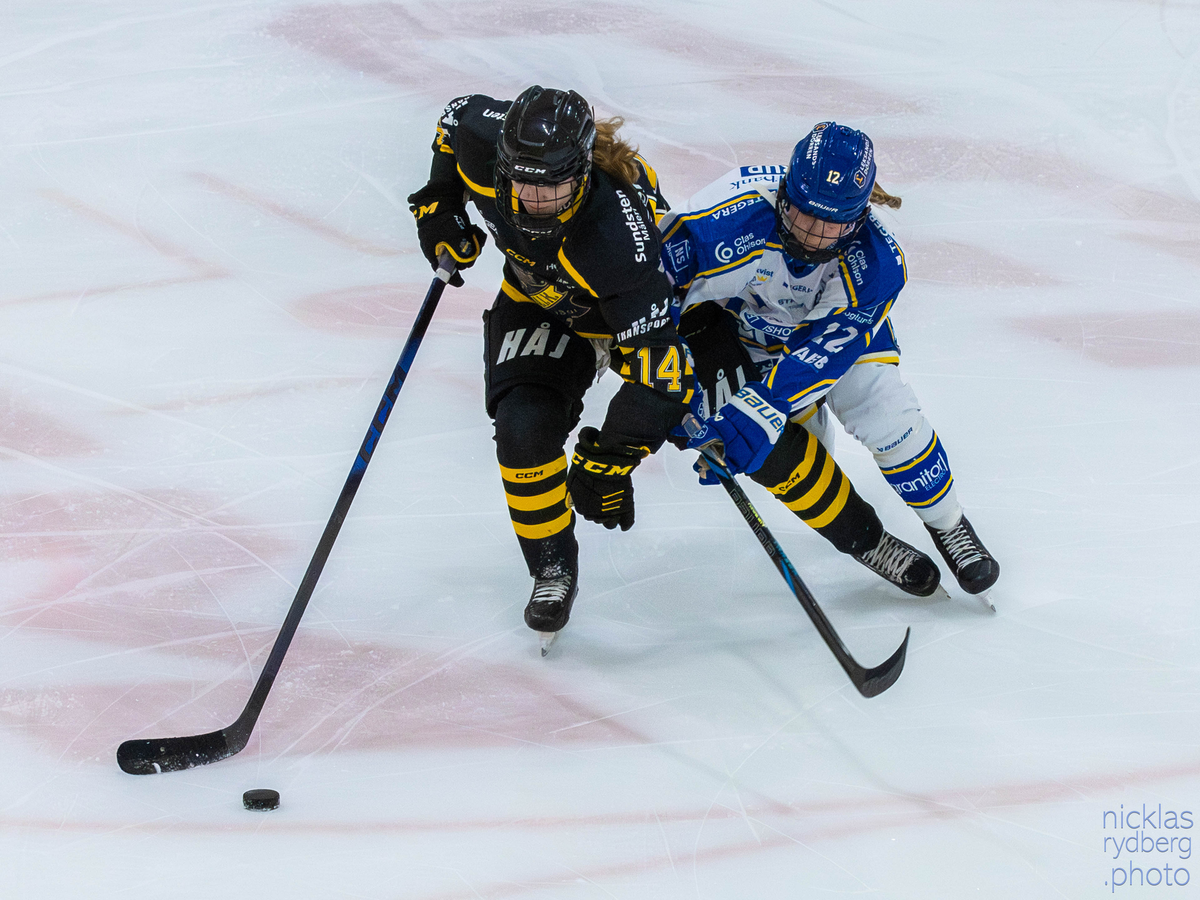
The Nationella Damhockeyligan (NDHL) is second highest professional women's in Sweden and part of the developmental pipeline for Swedish and European hockey talent. It boasts over 600 players from all over the world divided into 24 teams across four regions.
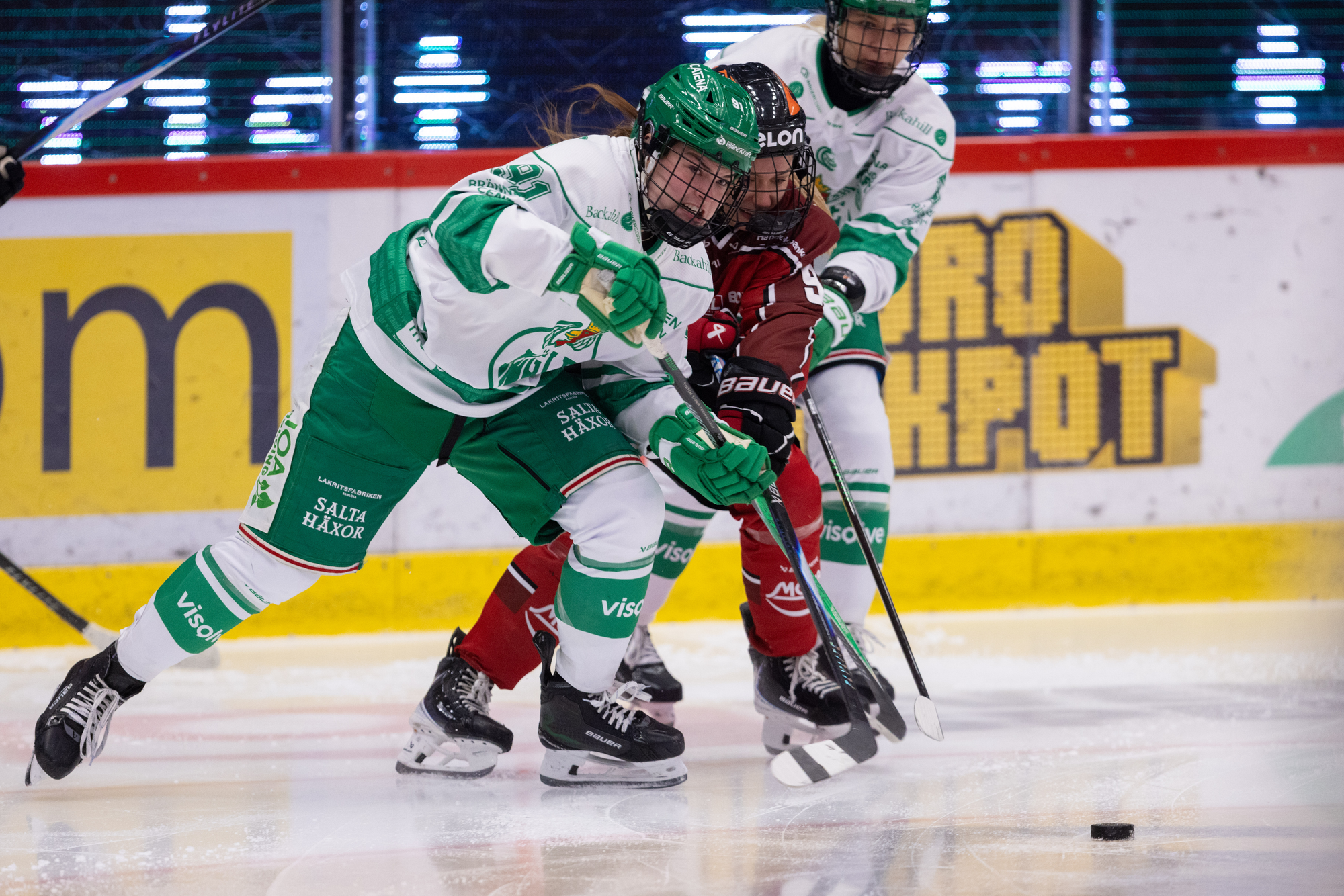
The SDHL and NDHL runs under the promotion-relegation system where the two worst performing teams in the SDHL must earn their keep against the two top performing teams in the NDHL at the end of the season. It creates higher stakes for both teams as relegation often comes with a hefty budget, while the flip side can bring revenue and resources to attract better players.
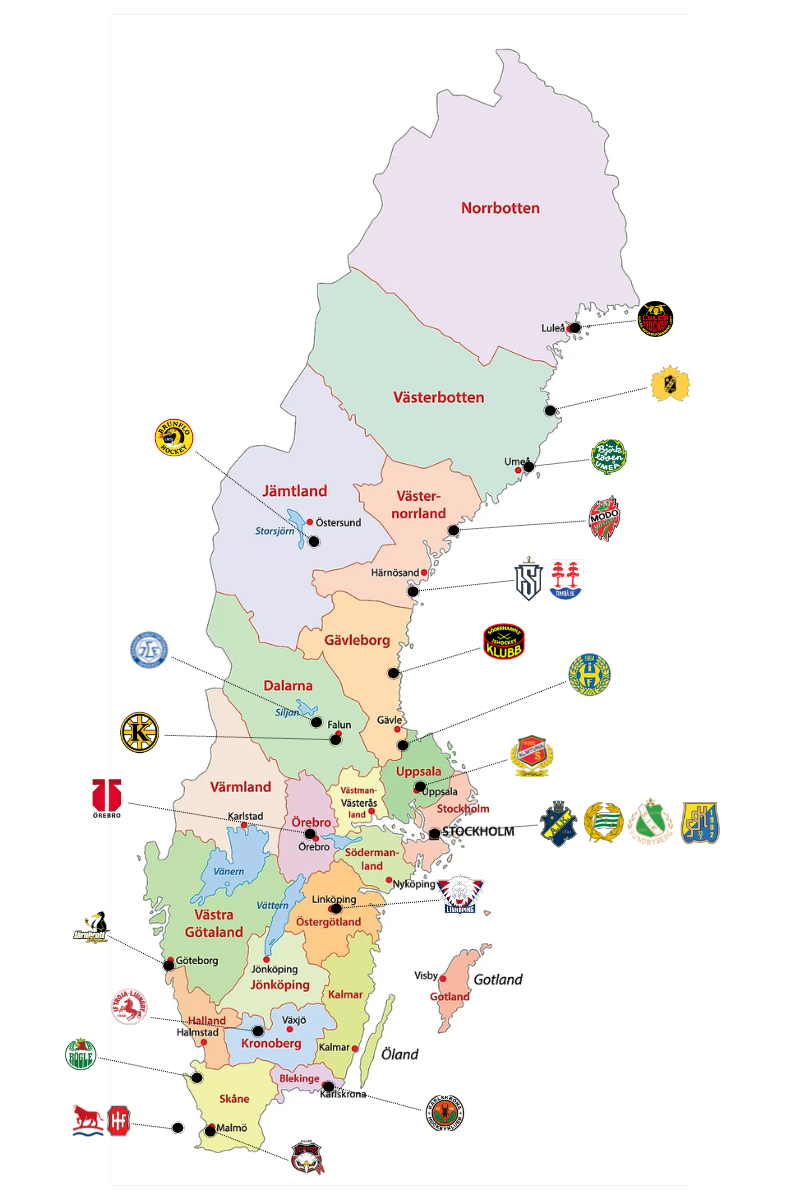
Unique to the NDHL, the teams are separated into four regions to begin and allows SDHL teams, such Luleå, Brynäs, and Linköping, to schedule games with their junior teams. Mid-November, the junior teams and any team without the financial resources to travel drop out and the top three teams from each region advance to Hockey Allsvenskan.
As the NDHL, now in Hockey Allsvenskan, breaks for the holidays – let's check in and see where the teams stand!
Mid-Season Check-In: North Division
The North Division hosts Leksands IF, AIK, IF Björklöven, Kvarnsvedens GolF, IF Sundsvall Hockey, and Timrå IK.
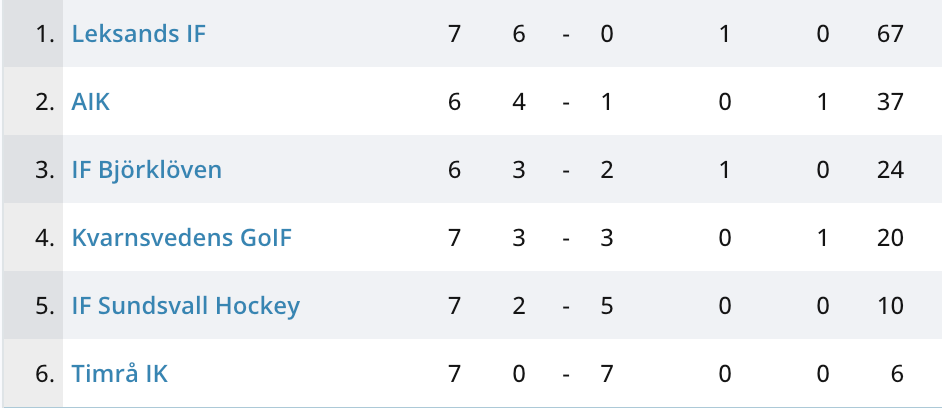
This division is dominated by the two former SDHL teams despite receiving a large roster and budget gut after their relegations. Timrå and Sundsvall were a combined team as recently as the 2022-2023 season and this is Kvarnsvedens GolF's first season as a team so the current outlook is not so surprising.
It's not always fair to write off teams early, but Timrå and Sundsvall are probably not strong enough this season for a come back. IF Björklöven will need to hit the ground running in January to keep up with AIK and stay ahead of Kvarnsvedens GolF. For the North Division so far, it looks like a battle for third.
Mid-Season Check-In: South Division
Örebro HK, Rögle BK, Malmö Redhawks, Hammarby IF, IF Troja-Ljungby and Södertälje SK form the South Division.
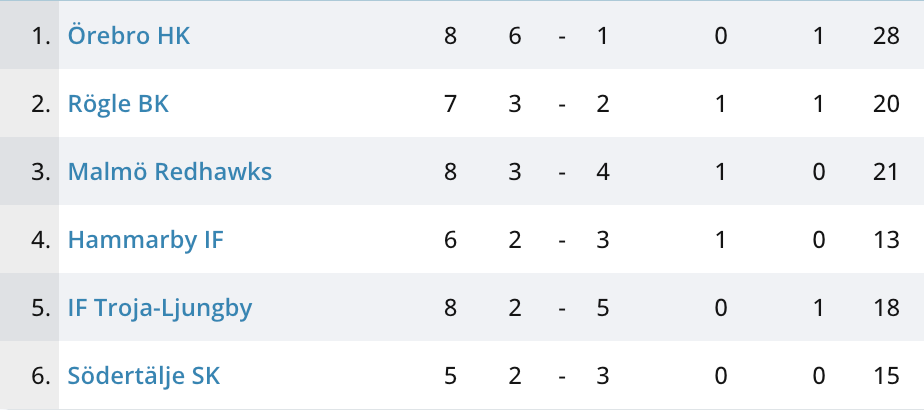
The South Division shows greater parity across the board comparing statistics like goal differential, but Örebro HK is the early front-runner with a nearly perfect record.
Södertälje is behind on games with only five, but they didn't play any games around the international break. They had potentially eight players missing for national camps, so perhaps that was a team choice. While they have some breathing room there, it's rumored that a couple key players received season-ending injuries in their most recent game against Rögle. Both teams are known for their physical play in this league.
There's also been speculation that high point-producing forward from an NDHL team that did not make Allsvenskan is joining Södertälje after the break. If that happens, hopefully their season can be somewhat salvaged as the competitive depth of the league would be reduced without them.
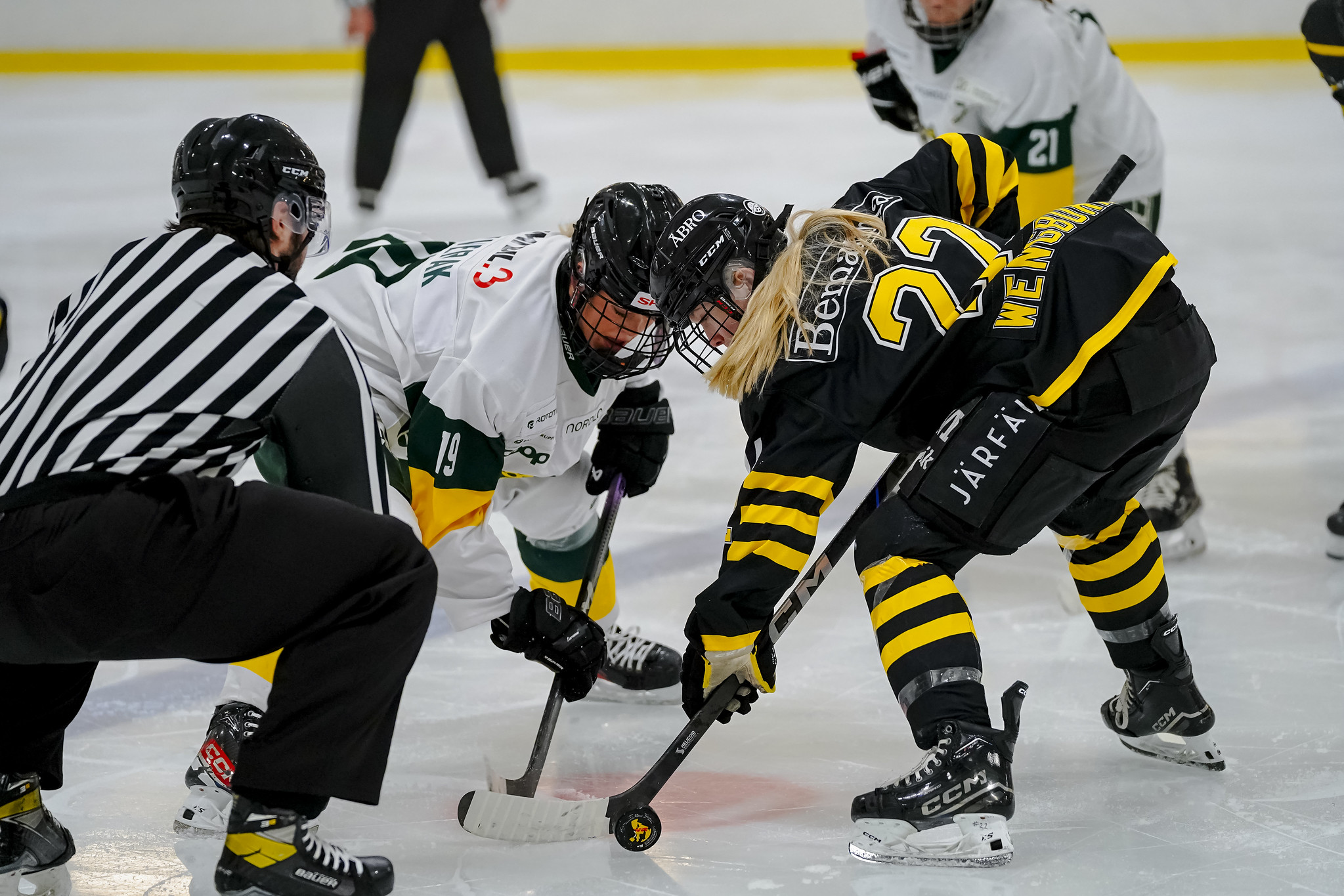
How Does a Current Player See It?
The talent improves overall in this league every year and confirmation of that is the two recent back-to-back NDHL promotions to the SDHL – Färjestad BK and Skellefteå AIK.
Many current NDHL teams are taking their SDHL chances seriously and have been putting resources behind that goal, like Rögle and Örebro. Despite the widening the resource gap between teams, it's always a positive sign when women's programs earn more investment from their club (although clubs are still quick to slaughter their budget if they can't meet expectations).
Outside of financial investment, though, it's difficult for any team to gain ground towards the SDHL when a majority of players on teams are in school or working. One of my teammates at Hammarby, for example, is a nurse and has come to a game directly after a full shift at the hospital (and played great!).
The "two-phase" season is a defining feature of the league and it was fun theorizing how teams would fair against each other once we moved into Allsvenskan. Since there are no "out of conference" games, we wouldn't see many NDHL teams until mid-November and some, maybe never. Also due to our (Hammarby) geographical location in Stockholm, we didn't even know if we would be in the North or South Division until a week before Allsvenskan started.
My team, Hammarby and our previous division rival, Södertälje, met again in the new South Division. Fortunately, since we had met Södertälje several times already, we knew what we were up against and had time to prepare. We had no idea, however, what to expect when it came to Rögle, Malmö, and Troja-Ljungby.
All three teams played together in the original South Division before Allsvenskan, but they played against each other less since they had two extra teams in their region. Rögle secured a perfect 12-0 record and only allowed 12 goals in total. At that point, we were thinking Rögle would continue steamrolling into Allsvenskan. In a small league, though, it's unrealistic to assume the best team will win every game or the worst teams will always lose (see: SDHL). The same applies here as Rögle stomped Troja-Ljungby and Malmö by over 8 goals but later lost to both teams in overtime.
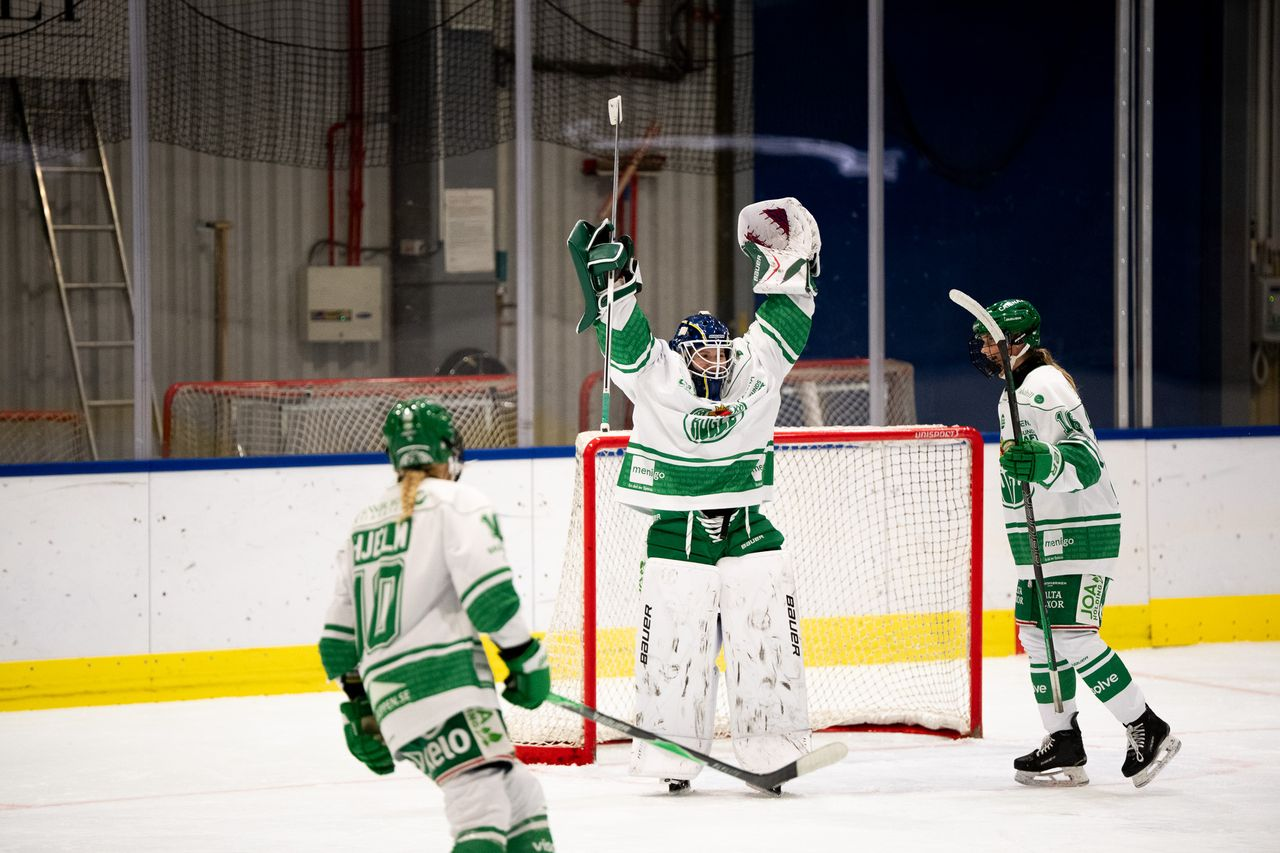
Örebro was the biggest mystery contender entering the South Division since I'd argue their original division was one of the weakest. Their only true opponent was Leksands and they met just twice, splitting 3-1 victories. Now with both teams currently sitting at the top of their respective Allsvenskan divisions, their contention is irrefutable.
I met with the General Manager of Örebro's women's team, Daniel Tagesson, last December and he mentioned their long-term goal was to reach the SDHL. At that time, he thought they'd need at least 2-3 more years to reach that milestone. Based on their performance so far this season, however, they might be moving up their timeline!
There has also been a few additional confirmed signings outside of the rumored Södertälje acquisition. Both Rögle and Malmö signed a new goaltender. Malmö sought 31-year old Canadian, Mariah Fujimagari, who has professional experience between the CWHL, NWHL, PHF and SDHL, while 23-year-old Team Czechia goaltender, Viktorie Svejdova, left HV71 for Rögle. They didn't get a ton of games in before the break, so it will be interesting to see if their contributions after break tighten up the scoreboard even more.
To summarize the South Division as a player I'd say: Örebro has the most balanced and consistent game play I've experienced. Rögle has the physicality, energy and resources behind a team clearly itching to take an SDHL position this season. Malmö favors skill and puck movement over pure speed and strength, which you can't count out in a diverse league like this. Troja-Ljungby also has a big, physical component to their game but are perhaps lacking on speed end. Södertälje is known for speed and strength, but their biggest asset is having a few elite snipers they can always rely on for points. And as for my team, Hammarby, I'd argue we have one of the strongest D-cores (including goaltenders), but still struggle converting offensively as a team and rely on one or two players to get all our points.
Physicality is becoming a defining feature of many teams, but most players don't know how to walk the line and often take risky penalties that leave them exposed to power plays. But that's what makes this league fun to play in. The teams have such a unique identity and nearly all the games are close in scoring.
League play resumes on January 7th with an anticipated South Division rematch between Malmö and Rögle while IF Björklöven vs. Timrå IK kick off the North Division the following night.
Comments ()