

A Nerdy Look at the Ottawa/Vancouver Trade, Part I: Vancouver's Point of View
The largest trade in terms of players in PWHL history has gone down. Dive deep into the numbers to gain a better understanding of why Vancouver made this trade & what to expect.
If you’re reading this, it’s probably because you saw a six-player trade go down between the Ottawa Charge and the Vancouver Goldeneyes. The Charge acquired forward Michela Cava, forward Brooke McQuigge, and blueliner Emma Greco. In exchange, the Goldeneyes acquired three forwards in Anna Shokhina, Mannon McMahon, and Anna Meixner. To date it is the largest PWHL trade in terms of players involved, and it has sent ripples through the league for a number of reasons. By now you’ve probably read a few articles or watched some videos analysing the trade. So, why read yet another article about this trade? I like to think I can offer a different perspective, looking past the names and into the numbers.
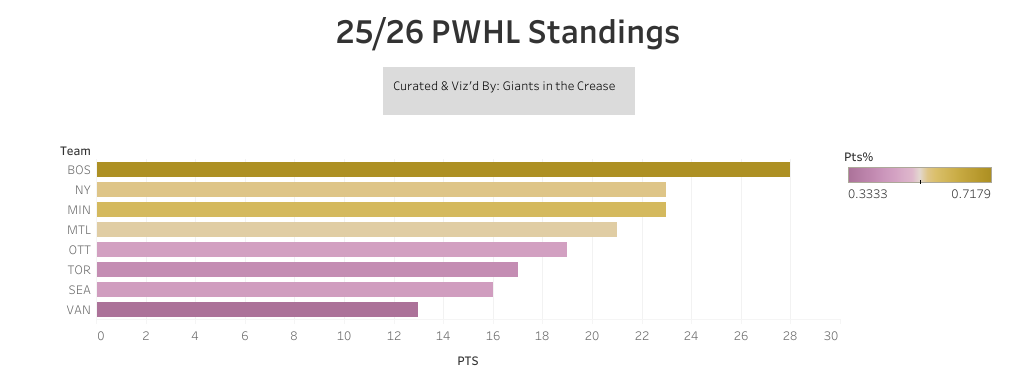
Let's start with a question: why are these teams making such a large trade? Even looking at surface level statistics, Vancouver's motivation seems rather obvious. Everything is going wrong for them, a team who a lot of fans and media declared as favourites to make it to the Walter Cup Final. Right off the bat you can tell they’re last in points and points percentage. In order to finish with a 0.500 win percentage (win%), they’d have to win 11 out of their next 17 games, which is a 0.647 win%. To put that into context, the only team above a 0.600 win% through the nearly first half of the season is Boston. Not impossible, sure, but maintaining that kind of win% through over half a season is difficult as a lot has to suddenly go very right for a long time. But this is hockey so, hey — anything is possible.
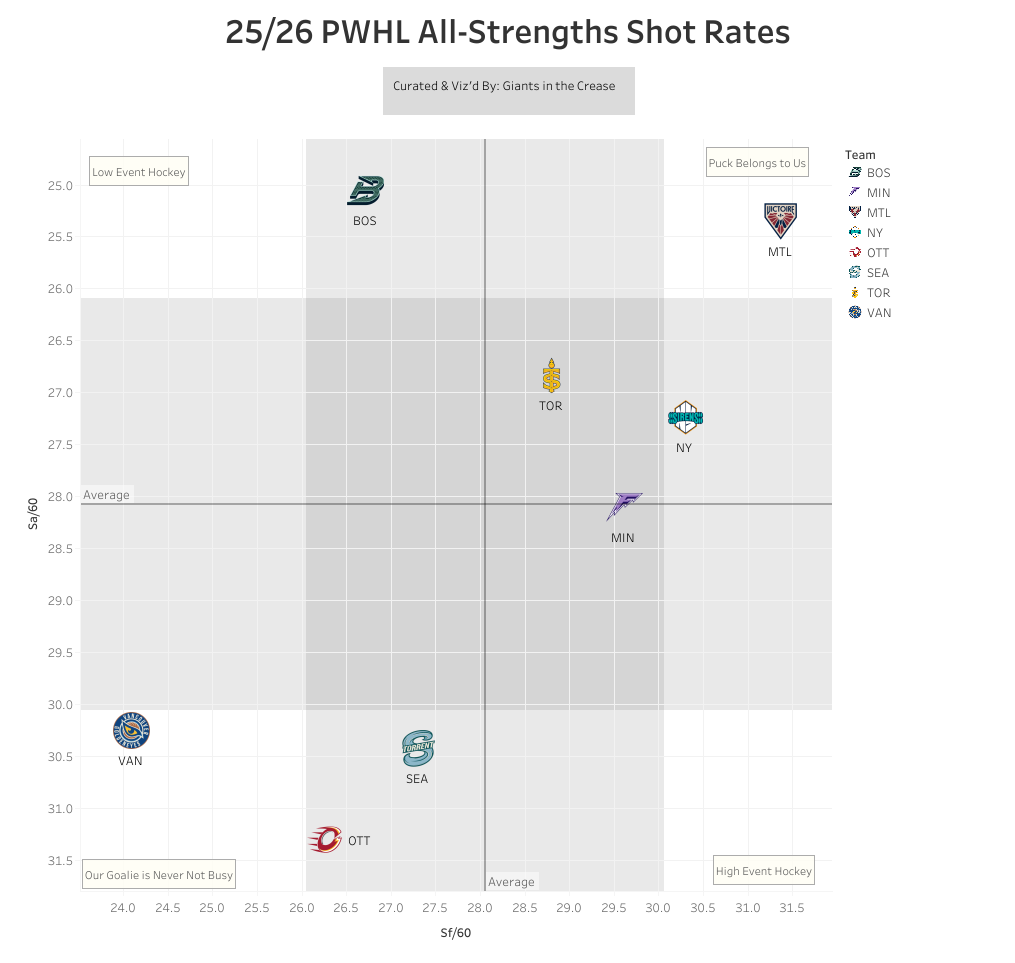
Being at the bottom of the standings is rough, though not exactly a reason to make such a large trade. Sometimes puck luck doesn’t go your way, and in such a small league, sometimes you spend some time at the bottom of the standings. For Vancouver, it's more than just being at the bottom of the standings. They’re the most outshot team in the league with a 44.34% Shots For%. We haven’t seen a team below a 45% shot share since the 2024 New York Sirens (44.98%), who hadn’t been named the Sirens yet. The result is the league's lowest goal share at 39.29% and at even strength their goal share is 38.64% — the only team with all strengths (-12) and even strength (-10) goal differentials in the negative double digits.
So, what if it’s a PDO problem? Wait — what is PDO?! This is commonly known as the “how lucky or unlucky a team is” stat, where you take the team save percentage (SV%) and add it to the team shooting percentage (SH%). The further away from 1.00 a team gets in either direction, the more unsustainable their team SH% or team SV% is. Typically, teams float between a 0.99 and 1.02 PDO to end the season. Currently, Vancouver is at a 0.991 PDO with their 0.922 team SV% and 0.0694 team SH%, which typically means there’s not much improvement to be made in the frequency goals are going in on the shots they’re taking or the shots coming in against them.
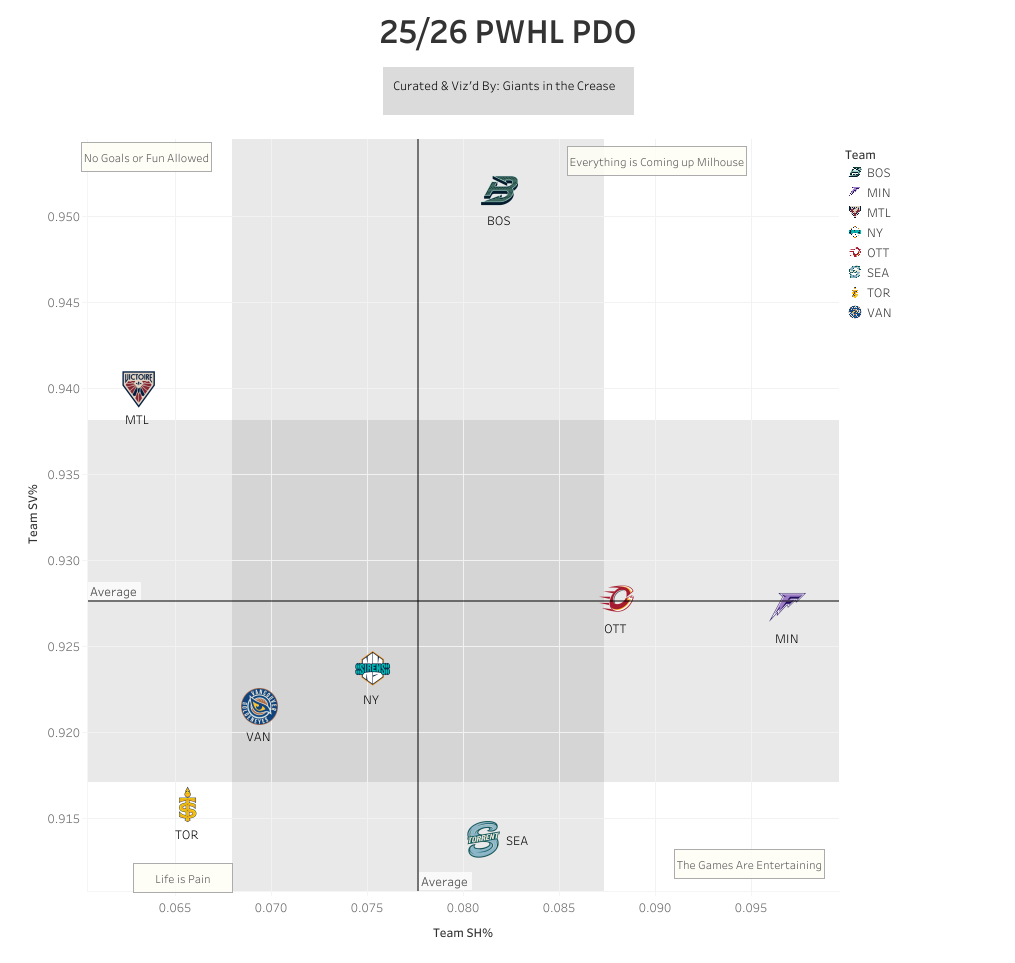
Where Vancouver might be due some positive statistical regression without making major changes is in their even strength (EV) PDO, which sits at a 0.985 EVPDO, with a league worst 0.919 team EV SV% and third-worst 0.066 team EV SH%. Once again, though, the problem is they’re getting caved in when it comes to shot share and this time at even strength it’s a 43.65% shot share. The only team below 20 EV Shots For/GP and above 25 EV Shots Against/GP. The team needs some kind of shake up as they’re just playing not good hockey too consistently to find success. All the numbers and even eye tests say they deserve to be where they are.
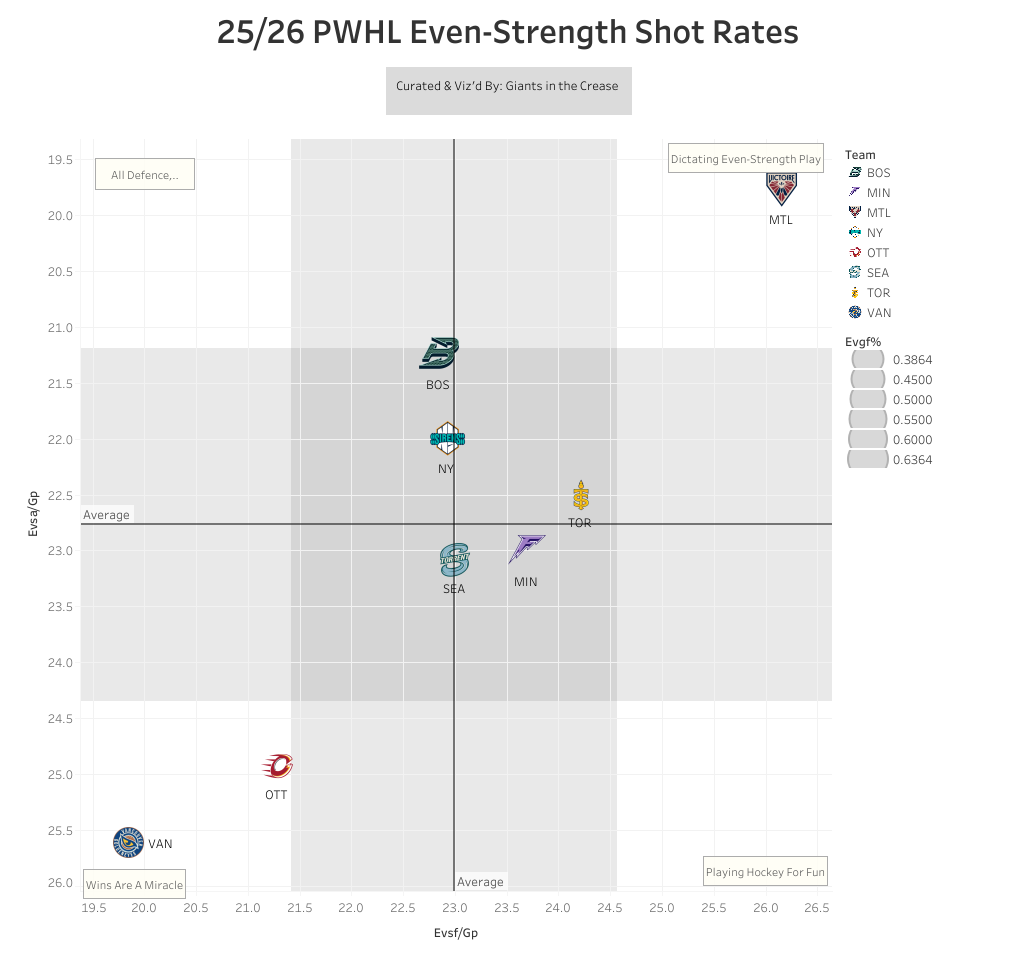
This is why, while the trade is understandable in that a trade happened involving Vancouver, it’s hard not to notice the general public confusion about the players Vancouver traded for. Anna Meixner, Anna Shokhina, and Mannon McMahon are the reinforcements? This is how the team is going to turn its season around? I’ll be honest with you in that I don’t think these players move the needle themselves in a direct way. What I think Cara Morey Gardner was thinking with this trade is to try to turn the team's luck around and maybe find yourselves on a PDO heater to bring your team into the playoffs.
We’ll start with Mannon McMahon, who is in her second season in the PWHL. Out of the three players added to the Vancouver roster, McMahon is the one with the highest floor. Her impact won’t be on the scoresheet, that’s not something she’s ever excelled in, but will be in adding stability and experience to the Vancouver bottom six. As part of the 2025 Ottawa Charge playoff run, McMahon, Gabbie Hughes, and Emily Clark were on the shutdown line that drove Marie-Philip Poulin insane. No one in Vancouver’s bottom six has that experience in being a shutdown forward with the success that McMahon had.
I’m sure Ottawa management was hoping for more of an offensive jump from McMahon this year and that hope was quickly dashed. This is probably why she was available. Last season, McMahon had a respectable four goals and eight points. Maybe she scored a bit higher than expected for a player of her ability, so regression was incoming, but I don’t think Ottawa was expecting McMahon to be on pace for four to five points. Still, she’s started to shoot the puck more, which is interesting. Don’t fear, Vancouver fans: I’m pretty sure that the expectations for McMahon in Vancouver are more Gabby Rosenthal level rather than Hannah Miller.
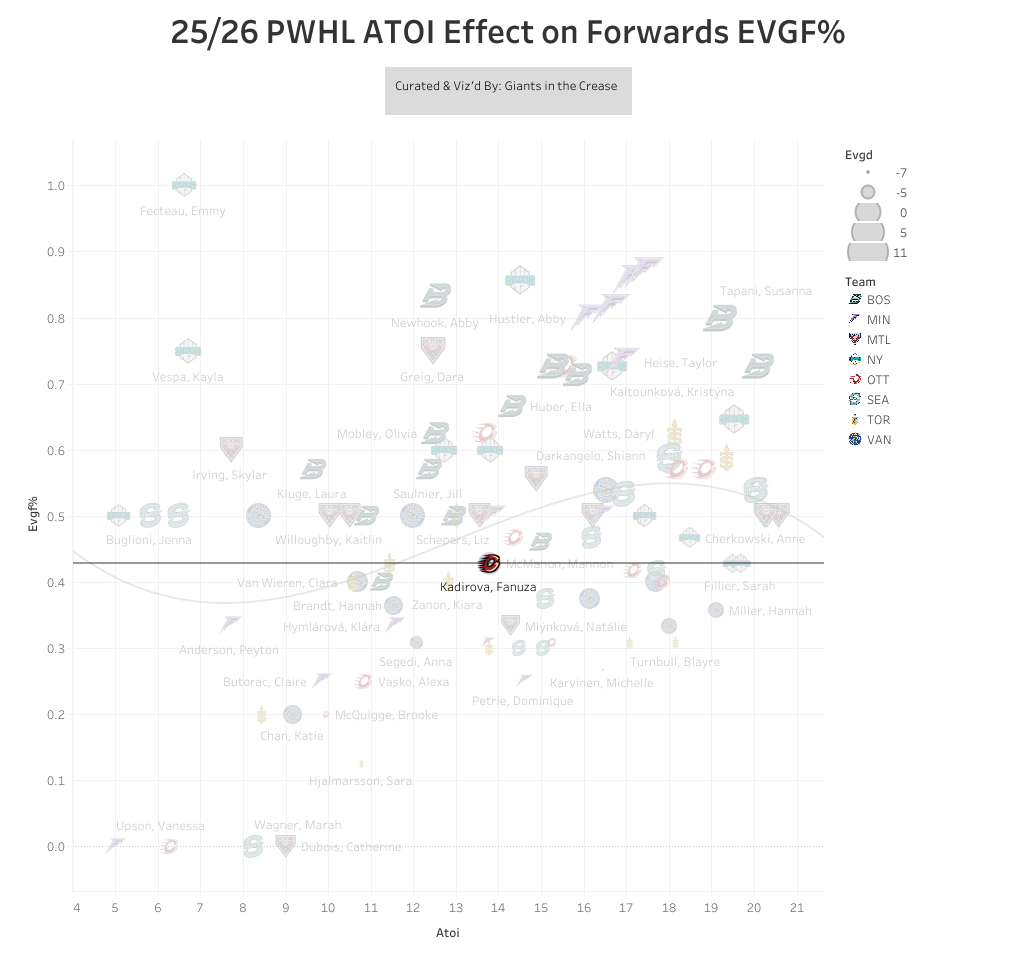
What Vancouver is bringing in McMahon for is her defensive impact and the fact that she can play center. The Anna Segedi as a bottom six center experience has gone completely wrong. I'm not blaming Segedi herself for the poor results of her line, though — she’s just a rookie and been surrounded by established PWHLers. Vancouver needs a different look and McMahon can provide that in being one of the few positively defensive impactful players that Vancouver now has.
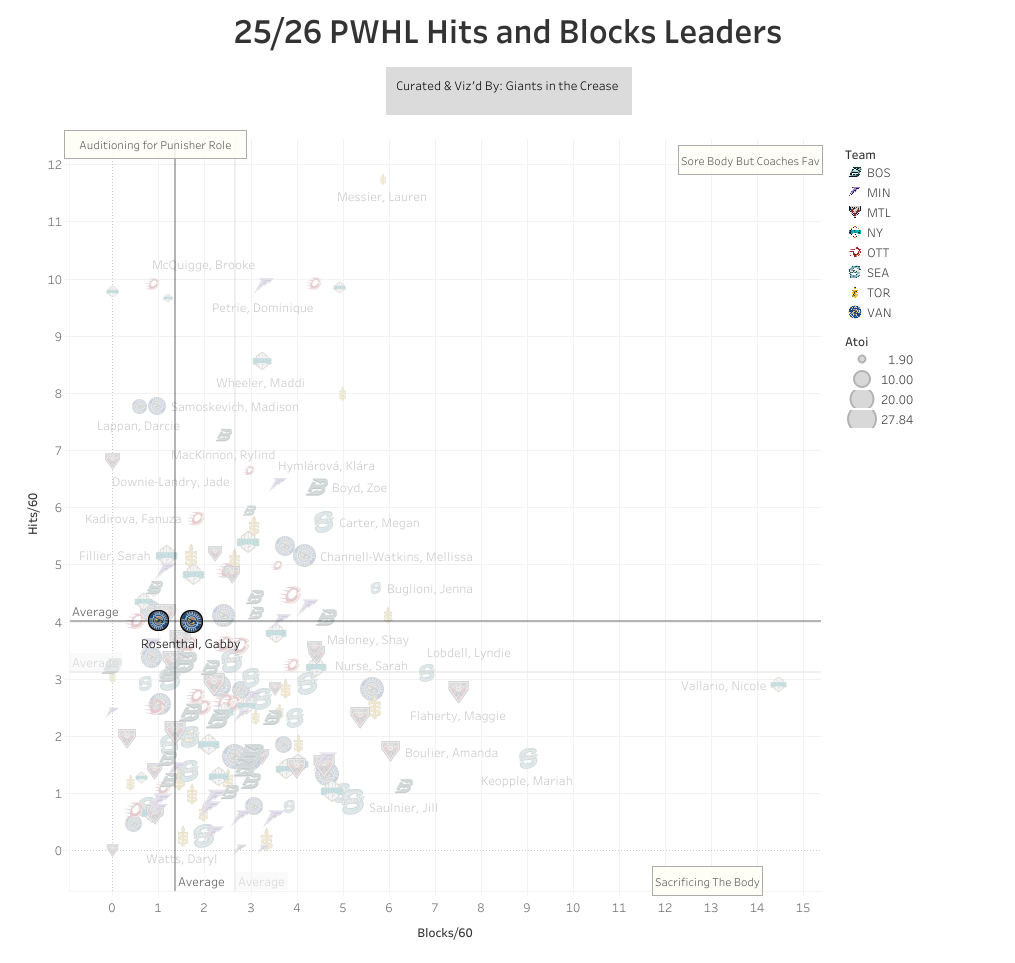
McMahon also provides hard forechecking and hitting. Vancouver now has the option to run a McMahon/Rosenthal duo on their third line and try to recreate some of the magic from the 2025 Ottawa playoff shutdown line. While Ottawa also bleeds shots against and goals against, and they rank fourth in most even strength goals against per game, McMahon hasn’t had that effect her numbers. She’s about in line for players with her minutes having a 0.31 EVGA/GP, matching the defensive numbers of Toronto and New York’s third lines, which is a significant improvement from Segedi or McQuigge.
Transitioning from the SDHL to the PWHL has proven to be a tough task for the forwards especially and Anna Meixner has not been immune to that rough transition. In the SDHL with Brynäs IF, Meixner was a very productive player, to the point where she earned the 22/23 SDHL MVP award as voted by the league as well as the MVP award voted on by the players — and brought her team to the SDHL Final as the cherry on top. When Ottawa drafted her in the 2024 PWHL entry draft I don’t know what the expectations were, but if it was to provide depth scoring you can see why they traded Meixner to Vancouver.
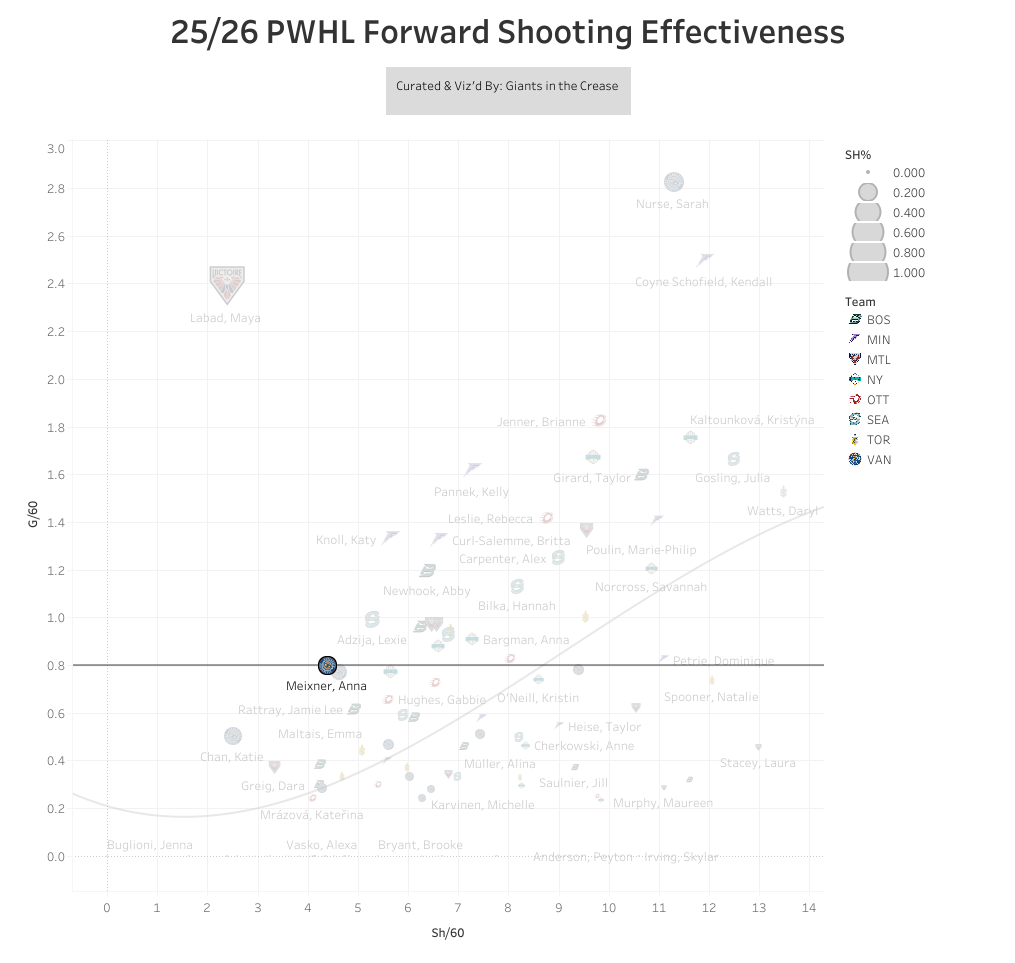
I'm not going to get on Meixner’s case too much about her rookie season in the PWHL. As far as I can tell she’s never played on a North American-sized rink as she spent her whole career in Europe. Meixner also saw her playing time most likely cut by more than half from her SDHL career to an average of 11:38 in the PWHL. It shouldn’t be much of a surprise that Meixner would go on to put up a mere two points, one of which was a goal. She wasn’t much of a shot producer either with 4.6 SOG/60. Not much is going to happen in that case.
So why is Vancouver trading for a 5’ 3”, 31 year-old forward whose offence has not translated from the SDHL to the PWHL? Losing Brooke McQuigge is taking away skill from the Vancouver bottom six, which Meixner can make up for. Meixner already has two goals this season, doubling her output from last season. When it comes to playoff experience both McQuigge and Meixner went to the Walter Cup final last season, so by adding Meixner you’re not losing the work ethic that is required of a player to do their job in the playoffs. To her credit as well, Meixner has changed her game for the bottom six and has added a physical element. She delivered 23 hits last season for a 4.2 hits/60, putting her in the same category as Sophie Shirley and Jill Saulnier. It’s slipped this season to 2.8 hits/60, but we know what Meixner is capable of.
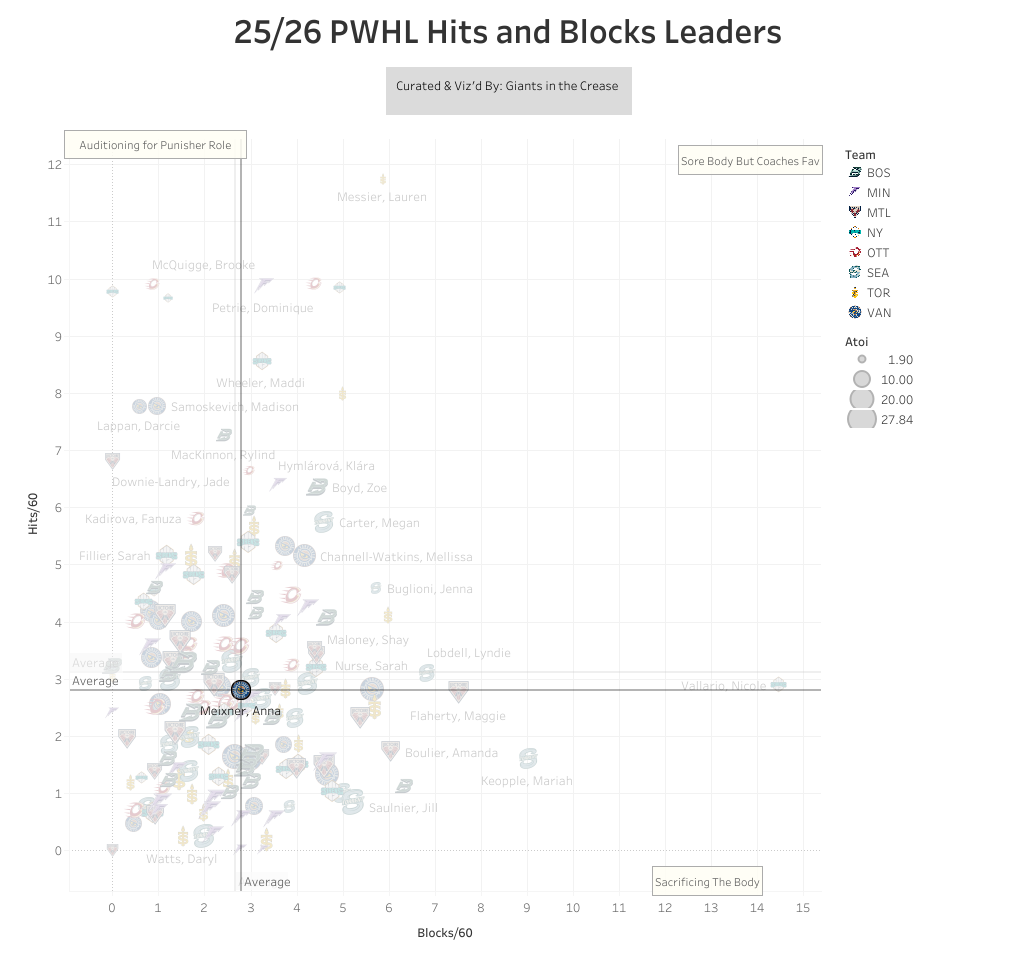
On the surface Meixner isn’t an impressive part of this deal, and realistically we’re looking at her continuing on this path of maybe adding a couple more points along with another goal. Maybe this doesn’t move the needle much, but I believe she’s being brought in to replace who McQuigge was in a bottom six role — this is what Meixner was already doing in Ottawa. Vancouver management had a plan for their bottom six and instead of forcing McQuigge into a lower role than she’s used to, you grab Meixner who can do the same job while also having a full season of experience in that role.
I mentioned above that Cara Morey Gardner made this trade to help the team's luck. It’s unrealistic to completely overhaul a roster just because it looks as though that might be needed for Vancouver to turn their fortunes. The best bet might just be going all in on one lucky shot to change their fortunes and win games against the odds — you could, after all, score the game winning goal after your goalie makes 40 saves on 41 shots, which is why I think Anna Shokhina was brought in via trade.
It’s pretty clear that when Ottawa drafted Shokhina in the second round of the 2025 PWHL entry draft, they wanted her to be an offensive magician. Not an unreasonable ask as Shokhina has shown to be an offensive magician in her time on the international stage and in the Russian Women’s League. In terms of pure skill, she’s in the upper echelon of that in the PWHL and it’s kind of translated to the PWHL — more so than we’ve seen from SDHL forwards coming to the PWHL.
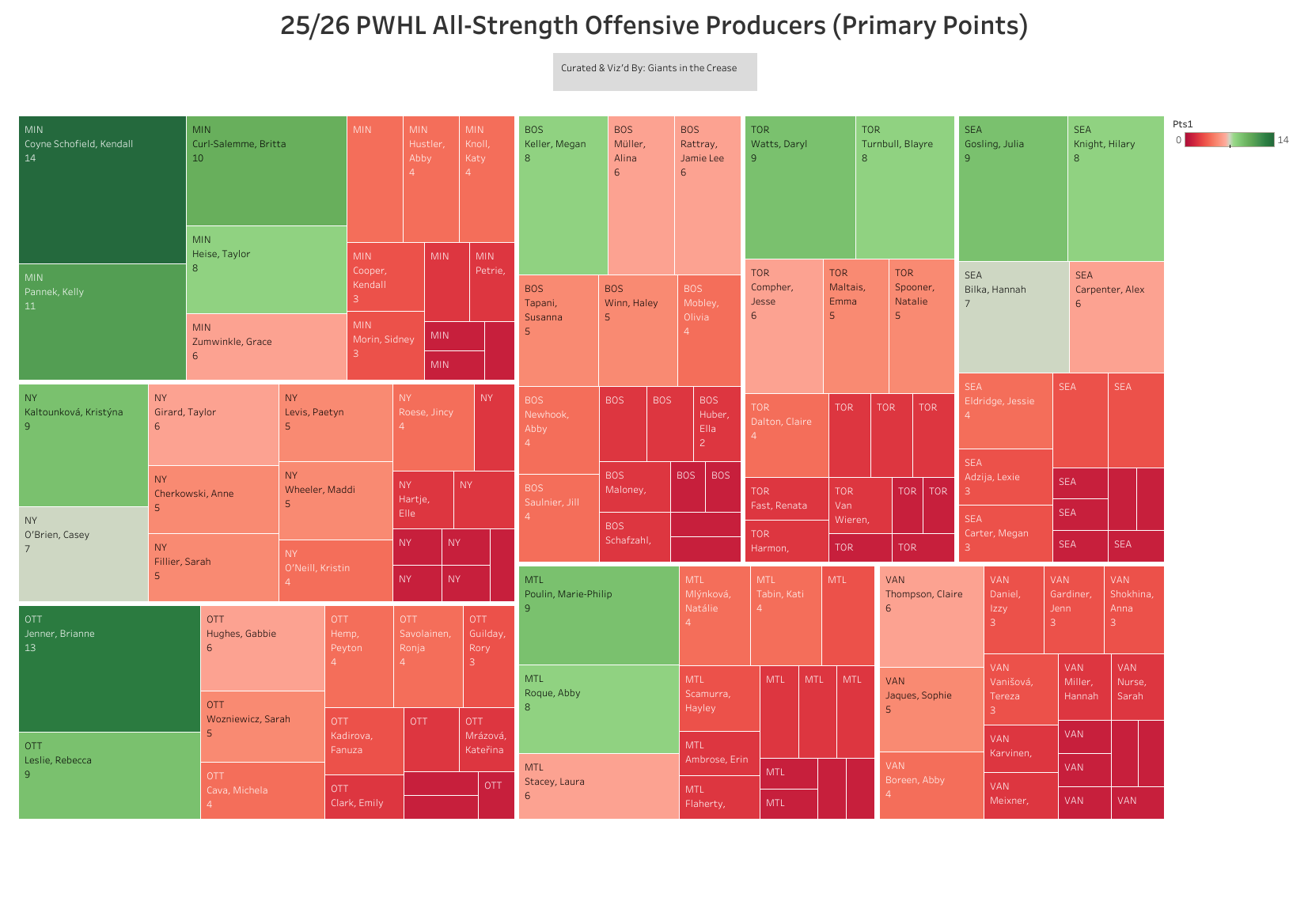
Currently Shokhina is sitting on four points in 12 games, which is more than Michelle Karvinen has and ties her with Fanuza Kadirova, to put her point totals into context. Shokhina is also currently rocking a 1.40 primary points/60, which is in the same range as Maddi Wheeler, Jesse Compher, Laura Stacey, etc. You’d probably like to see Shokhina generate more than 5.62 SOG/60 as she has a fantastic shot, though she’s not a volume shooter. If Vancouver can find a way to have Shokhina ride shotgun to two players who can drive play and allow her be a shark in the water for scoring chances, we’ll see that shooting percentage rise noticeably.
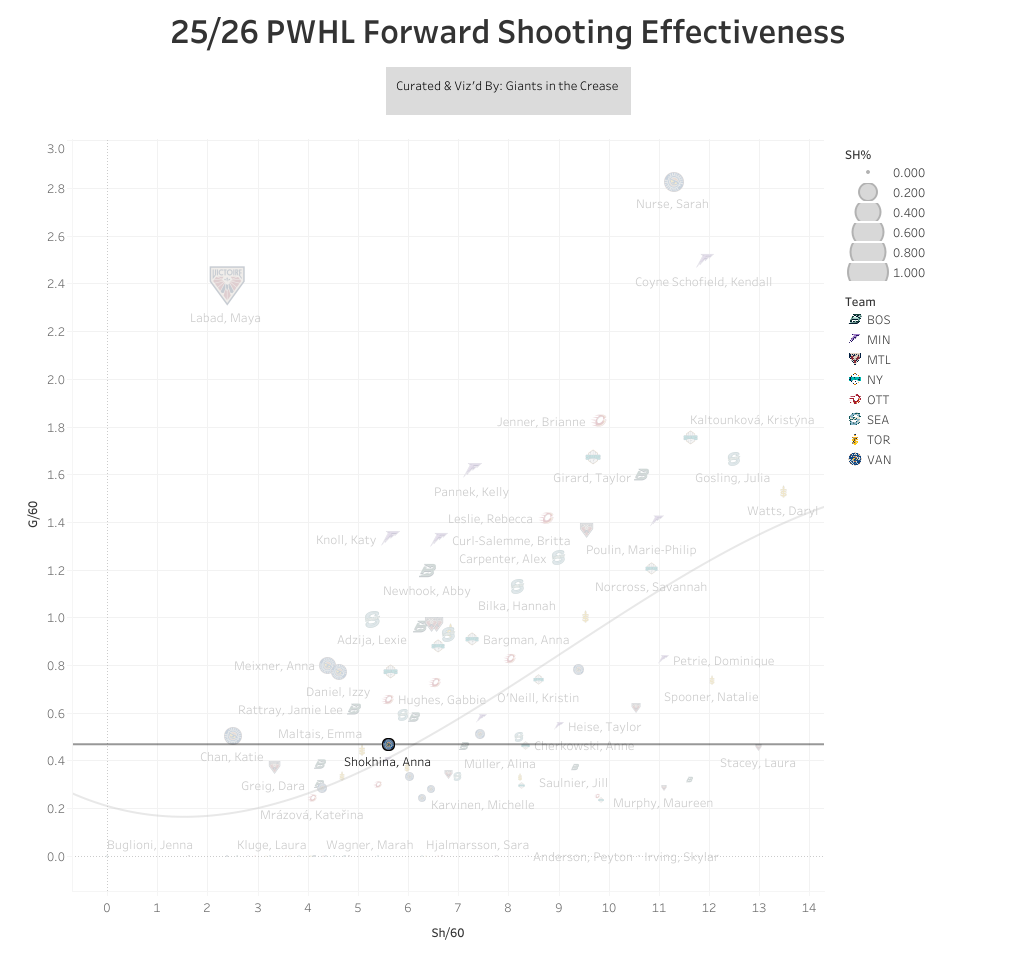
This is why adding Shokhina is making the big bet. Should Vancouver find the proper fit for her on a line to put her offensive IQ to the test, it won’t matter if Vancouver can’t completely change their shot metric and have a better on-ice process. All you need is a couple of great goal scorers finding the back of the net at the right time, and Vancouver added one in Shokhina. Idalski and the coaching staff just need to realize she’s not going to play a grinding game. This will be an experiment in making the most of Shokhina’s skill, in a way that Boston never figured out with Loren Gabel.
Comments ()